How are metamorphic rocks formed? The short answer
Short answer: metamorphic rocks form when an existing rock is changed by high heat, high pressure and hot, mineral-rich water, usually a mix of all three. These conditions are found deep underground and where tectonic plates collide. The rock never melts. Instead, its minerals slowly regrow, atom by atom, into new crystals, and the rock becomes denser and more compact.1213
The starting rock, called the parent rock, can be sedimentary, igneous or even an older metamorphic rock.18 Mud-rock (shale) becomes slate, limestone becomes marble, sandstone becomes quartzite, and granite can become gneiss.313 If the rock got hot enough to melt, it would turn into magma and cool into an igneous rock instead.1
What is a metamorphic rock?
A metamorphic rock is a rock that started out as a different rock and was transformed without melting. The word comes from the Greek for "change of form", the same idea as a caterpillar's metamorphosis into a butterfly.1413 It is one of the three main rock types, along with sedimentary rocks (made from settled layers of sediment) and igneous rocks (made from molten rock that cooled).3
Metamorphic rocks are often squished, smeared out and folded, because they were squeezed while they were hot.1 That's why many of them look striped or swirled, like the gneiss cliff at the start of the explainer. In Greenland, a single cliff of gneiss at Dickson Fjord rises more than 2,000 metres. It was once a pile of igneous and sedimentary rocks that were buried, folded and completely recrystallised.7
What does it take to change a rock? Heat, pressure, fluids and time
Geologists list five things that control what a rock turns into: the parent rock, the temperature, the pressure, the fluids (mostly water) and the time available.8
How hot is it down there? The Geological Society of London puts it neatly: in a mine 3 kilometres deep, the rock may be hot enough to boil a kettle.4 In the explainer's depth shaft, the temperatures come from that 30 °C per kilometre rule of thumb. Real places can be hotter or cooler, and the depth where rock starts to melt varies, so the shaft is not to scale.10
The one rule is that the rock must stay solid. The changes happen in the solid state: minerals react with each other and are replaced atom by atom.142 If a rock gets close to its melting point it may partly melt, making a mixed rock called migmatite. If it melts completely, it becomes magma.91
Why metamorphic rocks have stripes: foliation
Many metamorphic rocks have their minerals lined up in parallel sheets or bands. Geologists call this foliation, and it's what gives slate, schist and gneiss their layered look.1
Here's how it happens. Where plates collide, a rock is squeezed harder from one direction than the others.8 At the same time, the heat makes some of its minerals regrow. The new crystals, especially flat ones like mica, grow with their long sides at right angles to the squeeze. So instead of pointing every which way, they all end up lined up, and the rock develops a sheet-like structure that records the direction it was pushed.92
That's the big "aha": the stripes in a metamorphic rock are usually not the old sediment layers. They're new. In shale that becomes slate, the original bedding is largely wiped out, and the rock splits along the new mineral sheets instead.9 (The flake demo in the explainer is a cartoon, not to scale: the mica in slate is too small to see.)9
From shale to gneiss: the metamorphic grades
Shale is a rock made mostly of clay.20 Turn up the heat and pressure on shale, and it passes through a series of rocks. Geologists call the intensity of metamorphism its grade.9
Temperatures from Physical Geology (Earle), Table 7.1.9 They're approximate, because the pressure and the amount of water also matter. The heat slider in the explainer uses these same bands, so its numbers are rough guides too.911
Examples of metamorphic rocks and their parent rocks
Foliated metamorphic rocks
Slate, phyllite, schist and gneiss are foliated.2 Is gneiss a metamorphic rock? Yes: it's a banded, medium- to coarse-grained rock, often rich in quartz and feldspar, with dark and light bands of different minerals.15 Some of the oldest known rocks on Earth are gneiss. Parts of the Acasta Gneiss in northern Canada are more than 4 billion years old.16
Non-foliated metamorphic rocks
Marble, quartzite and hornfels are non-foliated.2 Is marble a metamorphic rock? Yes, it's metamorphosed limestone. As it forms, its calcite crystals grow larger and any fossils are destroyed. Pure limestone makes white marble; impurities give it swirly colours.9 Quartzite is metamorphosed sandstone, with its quartz grains welded together.9 Calcite and quartz crystals don't grow flat, so no matter how hard you squeeze, they won't line up in sheets.19
People have used metamorphic rocks for a long time. Marble and slate are two of the main natural stones cut for building.17 Slate splits into thin slabs that are used for roofing, and white marble has been carved into statues since ancient times.1819
Where are metamorphic rocks formed? Regional and contact metamorphism
Regional metamorphism: under mountains
Most metamorphic rock forms deep beneath mountain ranges, where rock is buried 10 kilometres or more and squashed by the movement of Earth's crust.4 This happens where tectonic plates collide and pile up mountains. (Curious what drives the plates? See what causes tectonic plates to move.) Because the rock has to be buried 10 to 20 kilometres down, huge areas are affected, often thousands of square kilometres. That's why it's called regional metamorphism.11
In the Himalayas, for example, some sedimentary rocks have been pushed up to nearly 9,000 metres above sea level, while others were buried to around 18 kilometres below the surface, where temperatures could reach about 500 °C.10 The strong squeeze of the colliding plates means regionally metamorphosed rocks are almost always foliated.11
Contact metamorphism: baked by magma
Rock can also be changed at shallower depths when hot magma, at around 1,000 °C, pushes up into it and bakes it.106 This is contact (or thermal) metamorphism. It only affects a thin zone around the magma, from a few centimetres beside a thin sheet of magma to tens or even hundreds of metres around a very large body.126 There's no strong squeeze, so the rocks it makes are not foliated: shale becomes hornfels, limestone becomes marble, and sandstone becomes quartzite.612 In the explainer's magma toy, the baked zone is drawn much bigger than real life so you can see it.
How do they reach the surface?
If metamorphic rocks form so deep, how can we pick them up? Over tens of millions of years, the mountains above them are worn away by rivers and glaciers, and rocks can also be pushed up along faults. The once-buried rock ends up at the surface.58 In the US you can see metamorphic rock in places such as Rocky Mountain, Grand Teton and Shenandoah national parks.2
Metamorphic rocks and the rock cycle
All rocks are linked in a never-ending loop called the rock cycle.3
- Worn down at the surface, a metamorphic rock breaks into sediment, which can become new sedimentary rock.13
- Buried deeper and heated more, it can change again into a higher-grade metamorphic rock.1
- Melted, it becomes magma, which cools into igneous rock.13
Metamorphism also makes treasures: garnets grow in schist,9 and hot fluids from magma can leave veins of quartz and even gold in the surrounding rock.12 For another story of carbon changed by extreme pressure deep underground, see how diamonds are made.
Try it at home: squash a clay mountain (no heat needed)
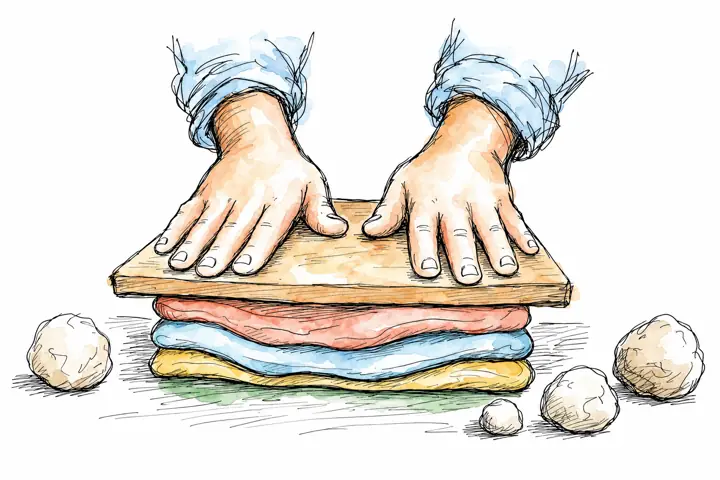
- Roll out four thin sheets of different-coloured modelling clay and stack them like a layer cake.
- Press sideways from both ends with your hands or two books. Watch the layers bend and fold, like rock squeezed where plates collide.
- Now mix a few tiny flat flakes (snipped bits of paper or glitter) into a ball of clay, pointing every which way. Flatten the ball firmly with a board.
- Cut it open with a blunt plastic knife: most flakes now lie flat, at right angles to your push.
This is a model, not real metamorphism. In real rocks, heat, pressure and fluids drive changes that usually take millions of years, and much of the lining-up happens as new minerals grow at right angles to the squeeze, but the direction rule is the same.89 No heat, sharp tools or chemicals needed.
Common misconceptions
"Metamorphic rocks are melted rocks." They change while staying solid. Melted rock cools into igneous rock.113
"Pressure alone does it." Heat, pressure and hot fluids usually work together.1 Contact metamorphism is mostly heat.6
"Only sedimentary rocks turn metamorphic." Any rock can: granite can become gneiss.13
"All metamorphic rocks are striped." Marble, quartzite and hornfels usually have no stripes.2
"The stripes are the old sediment layers." Foliation is new: minerals regrow lined up at right angles to the squeeze, and the old layers are mostly wiped out.9
FAQ
How are metamorphic rocks formed, in a short answer?
Metamorphic rocks form when an existing rock (igneous, sedimentary or an older metamorphic rock) is changed by high heat, high pressure, hot mineral-rich fluids or, most often, a combination of these, deep underground or where tectonic plates meet. The rock stays solid: its minerals slowly recrystallize or react to form new minerals, often making the rock denser and more compact. If it melted, it would become magma and then igneous rock instead.
How do metamorphic rocks form, for kids?
Imagine a rock getting buried deeper and deeper. The rocks on top press down on it, and it gets hotter the deeper it goes. Over millions of years, the heat and squeezing change the tiny crystals inside it, without melting it. Mud-rock called shale can turn into slate, and limestone can turn into marble.
Where do most metamorphic rocks form?
Most form deep beneath mountain ranges, where tectonic plates collide and rock is buried 10 kilometres or more, heated and squeezed over large areas. This is called regional metamorphism. Smaller amounts form next to hot magma that bakes the rock around it, which is called contact metamorphism.
How can I tell if a rock is metamorphic?
Look for clues: thin flat sheets that split easily (slate), a silky shine (phyllite) or glittering mica flakes you can see (schist), light and dark bands that may be folded or wavy (gneiss), or a sugary mass of interlocking crystals (marble and quartzite). Minerals lined up in one direction, called foliation, are one of the best clues, but marble and quartzite usually have no stripes.
Can metamorphic rock turn into igneous rock?
Yes. If a metamorphic rock is buried so deep that it gets hot enough to melt, it becomes magma. When that magma cools and hardens, it forms igneous rock. A rock that only partly melts can become a mixed rock called migmatite.
What are the two types of metamorphic rocks?
Foliated rocks have their minerals lined up in sheets or bands, such as slate, phyllite, schist and gneiss. Non-foliated rocks, such as marble, quartzite and hornfels, lack these lined-up mineral sheets, usually because their main minerals don't grow flat or because they formed without strong squeezing from one direction.
How long does it take for metamorphic rock to form?
Usually millions of years. New mineral crystals have been estimated to grow only about a millimetre per million years, and the mountain building that buries rocks deep enough takes tens of millions of years. Bringing the rock back to the surface by uplift and erosion takes tens of millions of years more.
How do metamorphic rocks get back to the surface?
They are pushed up, for example along faults, while rivers and glaciers wear away the mountains above them. After tens of millions of years, rock that formed many kilometres down can end up at the surface, where we can see it in places such as Rocky Mountain, Grand Teton and Shenandoah national parks.
Sources
- USGS, What are metamorphic rocks?
- US National Park Service, Metamorphic Rocks
- British Geological Survey, Rocks and minerals
- Geological Society of London, Metamorphism
- Geological Society of London, Regional metamorphism
- Geological Society of London, Contact metamorphism
- Geological Society of London, Deformation and metamorphism
- Earle, Physical Geology 2nd ed. (BCcampus open textbook), 7.1 Controls over metamorphic processes
- Physical Geology 2nd ed., 7.2 Classification of metamorphic rocks
- Physical Geology 2nd ed., 7.3 Plate tectonics and metamorphism
- Physical Geology 2nd ed., 7.4 Regional metamorphism
- Physical Geology 2nd ed., 7.5 Contact metamorphism and hydrothermal processes
- National Geographic Education, Metamorphic Rocks
- Encyclopaedia Britannica, Metamorphic rock
- Encyclopaedia Britannica, Gneiss
- Smithsonian Magazine, The secrets of how life began may be hidden inside the world's oldest rocks (2025)
- USGS National Minerals Information Center, Dimension stone
- Encyclopaedia Britannica, Slate
- Encyclopaedia Britannica, Marble
- USGS, What are sedimentary rocks?