1
Zoom into two bowls
Cane vs. beet sucrose
Look very close!
Tap a bowl. What are the crystals made of?
Magnify each bowl: is there any chemical difference?
Tap a bowl. What do you see?
Your turn
Each lab is one step from the video. Change things and see what happens.
Each lab isolates one step, from leaf to crystal. The models are simplified to show the idea.
Tap the buttons and see what happens.
Tap a bowl. What are the crystals made of?
Magnify each bowl: is there any chemical difference?
Tap a bowl. What do you see?
Switch between sugarcane and sugar beet. Where does each plant keep its sugar?
Compare stalk storage in cane with root storage in beet.
Tap cane or beet. Where is the sugar?
Crush the cane, or soak the beets. How does the sugar come out?
Roller milling for cane, hot-water diffusion for beet cossettes, then lime clarification.
Squash the cane, or soak the beets.
Boil, add seeds, then spin. What happens if you add seeds too early?
Concentrate past saturation, seed, then separate crystals from molasses.
Boil it. Add seeds. Spin it!
Meter levels are simplified.
Slide the molasses up and down. Which sugar do you get?
Vary the molasses film from refined white to dark brown sugar.
Slide it. What colour is the sugar?
Drag along the timeline, from New Guinea to today.
Step through domestication, crystallisation, trade, plantations and beet sugar.
Slide along the timeline.
Sugar comes from plants! Green leaves use sunshine to make sugar. That is called photosynthesis.
Sugarcane is a giant grass. It keeps sugar in its tall stalks, and it likes hot, rainy places. The sugar beet likes cooler places. It keeps sugar in its fat white root.
At the mill, big rollers squash the cane. Out comes sweet juice! Beets are cut up and soaked in hot water, and the sugar comes out.
The juice is boiled until it is thick and sticky. Tiny bits of sugar are added, and crystals grow on them. A fast spinning machine keeps the crystals and throws away the dark syrup.
Sugar from a cane mill is golden. Clean it and crystallize it again, and it turns white. Add dark syrup, and you get brown sugar.
Almost all table sugar comes from two plants: sugarcane, a giant grass that grows in hot, rainy places, and the sugar beet, a pale root crop grown in cooler regions.1 Both make sugar the way every green plant does, by photosynthesis. They use the energy in sunlight to turn water and carbon dioxide into sugar.12 What makes these two plants special is that they stockpile it. Cane stores sugar in its thick stalks and the beet stores it in its root.1
Factories don't invent sugar. They get the sugary juice out of the plant, clean it, boil it down and let the sugar grow into crystals.1 About four fifths of the world's sugar comes from cane and about one fifth from beets.3
The sugar in your sugar bowl is sucrose. It's a "double sugar": one molecule of glucose joined to one molecule of fructose. Its formula is C12H22O11.1 Almost every plant contains some sucrose, but only sugarcane and sugar beets hold enough of it to be worth extracting. (Maple sap and date palms are small extra sources.)1
| Sugarcane | Sugar beet | |
|---|---|---|
| What it is | A giant perennial grass | A root crop, a cousin of the garden beet |
| Where it grows | Tropical and subtropical places | Cooler, temperate places |
| Where the sugar is | In the jointed stalks, 3–7 m (10–24 ft) tall | In the white root, 1–2 kg (2–4 lb) |
| Sugar by weight | About 7–18% | About 8–22% |
| Share of world sugar | About four fifths | About one fifth |
| After harvest | Spoils fast, milled near the field | Can be stored for a while |
Sources for the table: Britannica's articles on sugar, sugarcane and sugar beet.123
Yes, once it's refined. White cane sugar and white beet sugar are both pure crystallized sucrose, the same molecule, much as pure salt is always sodium chloride.4 That's why packets rarely say which plant the sugar came from.4 Any differences come from tiny amounts of other substances left in less refined sugars.1
Once cane is cut, its sucrose starts breaking down, so the stalks are rushed to a mill near the fields.16 There:
The result is raw sugar: pale brown to golden crystals that are 97–99% sucrose.1 Much of it is shipped to refineries in the countries that use it.1
Beets take a gentler route. They're washed and cut into thin V-shaped strips called cossettes, which gives lots of surface for the sugar to escape from. The strips move through a long tank called a diffuser, against a stream of hot water kept above 75 °C (167 °F). The water pulls about 98% of the sugar out.1 From there the steps look like the cane steps: clean, boil down, seed, crystallize and spin. The difference is that beet factories go straight to white sugar in one stage.1 The leftover beet pulp becomes animal feed.1
Crystals aren't stamped out by a machine. They grow themselves. Water can only hold so much dissolved sugar. When a syrup is boiled until it holds more than it normally could, it's called supersaturated, and the extra sugar is ready to come out.1 Add a few tiny seed crystals and sugar molecules begin stacking onto them in a neat, repeating pattern, making each crystal bigger.1 Factories boil under a vacuum so the syrup boils at a lower temperature.1
clean juice (~1/8 sugar) → syrup (over 1/2 sugar) → supersaturated + seeds → crystals + molasses
The sugar meter in the player's "Growing the crystals" chapter is simplified: its levels show the idea, not exact factory readings.
Molasses is the dark syrup left over after sugar crystals are taken out. The centrifuge spins it off the crystals.5 Factories crystallize the syrup several times over. Each round leaves darker, less sweet molasses, ending with thick blackstrap molasses.15 Lighter cane molasses is used in baking and candy. Beet molasses isn't pleasant to eat and mostly becomes animal feed.5
Brown sugar is sucrose crystals with molasses kept on them or added back. It's either crystallized from syrups that still contain molasses, or made by coating white crystals with molasses.1 More molasses means darker, stickier, more strongly flavoured sugar. Beet factories only make white sugar, so brown beet sugar is made by adding molasses from cane.14
| Sugar | What it is |
|---|---|
| White (granulated) | Refined, nearly pure sucrose crystals |
| Raw cane sugar | Golden crystals with a thin film of molasses, 97–99% sucrose |
| Light brown | Sucrose crystals with a little molasses |
| Dark brown | Sucrose crystals with more molasses |
| Powdered (icing) | White sugar ground fine, with a little starch to stop clumping |
Sources: Britannica, Sugar (crystallization and refining).1
At a refinery, raw cane sugar is washed in warm syrup to loosen its molasses coating, then spun, dissolved in hot water, cleaned and filtered. It's then passed through filters that take out the colour and crystallized again in vacuum pans, and the crystals come out white.1
New Guinea, thousands of years ago. Sugarcane was first domesticated in New Guinea, roughly 8,000 to 10,000 years ago. For a long time people simply chewed the stalks for their sweet juice.187
India: the first crystals. People in India were the first to boil cane juice into solid sugar crystals that could be stored and traded, more than 1,500 years ago.713 The Sanskrit word śarkarā (gravel, grit) passed through Persian and Arabic to become our word "sugar", and "candy" comes from the Sanskrit khanda.13
West along the trade routes. By the 500s CE sugar was grown in Persia, and the medieval Arab world carried it across the Middle East and the Mediterranean.137 In Europe it stayed a costly luxury for centuries.7
Atlantic plantations. From the 1500s, European colonists built huge sugar plantations in Brazil, the Caribbean and later North America, and those plantations relied on the forced labour of enslaved Africans. Between 10 and 12 million Africans were taken across the Atlantic in the slave trade, and sugar was one of its main products.97
Sugar from beets. A German chemist, Andreas Marggraf, first got sugar out of beets in 1747. The first beet sugar factory opened in 1802, and from 1811 Napoleon promoted beets because a British blockade had cut France off from Caribbean cane sugar.3
Today. In the United States, about 55–60% of home-grown sugar comes from beets and 40–45% from cane (USDA ERS figures; cane is grown mainly in Florida and Louisiana).6 Sugar is in a huge range of foods. The World Health Organization recommends that adults and children keep free sugars (added sugars plus the sugar in honey, syrups and fruit juice) below 10% of the energy they eat each day.10 Sugar also feeds the mouth bacteria that cause cavities.
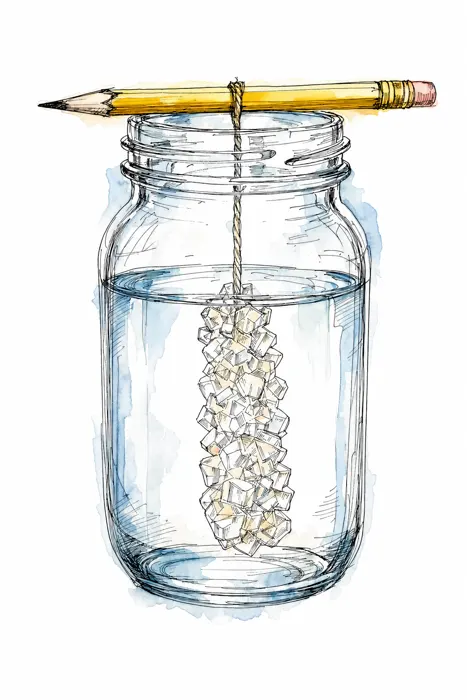
Do this with an adult. The syrup gets very hot and can burn badly.11
You've just done a small version of what a sugar factory does: make a supersaturated syrup and give the sugar something to grow on. Most chocolate has sugar crystals in it too. See how chocolate is made. Want another sweet thing from nature? See how bees make honey.
The sugar itself is natural. Plants make sucrose by photosynthesis and store it; sugarcane keeps it in its stalks and sugar beets in their roots. Factories don't create sugar. They squeeze or soak it out of the plant, clean the juice, and let the sugar crystallize.
White sugar comes from sugarcane or sugar beets. Beet factories usually make white sugar in one go, at the same plant. Cane is first made into golden raw sugar near the fields, then refined: washed, dissolved, cleaned and crystallized again until the crystals are pure white sucrose.
1) Crush cane (or slice beets and soak them in hot water) to get sugary juice. 2) Clean the juice with heat and lime so mud settles out. 3) Boil it down into a thick syrup. 4) Add tiny seed crystals so sugar crystals grow. 5) Spin the mix in a centrifuge to separate the crystals from molasses. 6) Dry the crystals, and refine them further for white sugar.
Chemically, no. Refined cane sugar and refined beet sugar are both pure sucrose, the same molecule, so you can't tell them apart by taste or ordinary chemistry (only special lab isotope tests can). Differences only come from the small amount of other substances left with less refined sugars.
Brown sugar is sucrose crystals with molasses on them. It's either crystallized from syrups that still contain molasses or made by coating white sugar crystals with molasses. The more molasses, the darker and stickier it is. Brown beet sugar uses molasses from cane.
The United States grows both crops. Since the mid-2000s about 55 to 60 percent of US-made sugar has come from sugar beets (grown in 11 states, such as Minnesota, North Dakota and Idaho) and 40 to 45 percent from sugarcane grown mainly in Florida and Louisiana. The US also imports some sugar.
Sugarcane was first domesticated in New Guinea, roughly 8,000 to 10,000 years ago, where people chewed it for its sweet juice. People in India later learned to boil cane juice into crystals, and the Sanskrit word śarkarā gave us the word 'sugar'.